

Spain are world champions again.
Sixteen years after Andrés Iniesta’s unforgettable goal delivered Spain’s first FIFA World Cup title in South Africa, La Roja returned to the top of world football by winning the 2026 FIFA World Cup.
Their journey was not built around overwhelming scorelines in every match. Instead, Spain combined possession, intelligent pressing, midfield control and an extraordinary defensive record to navigate the biggest World Cup ever staged.
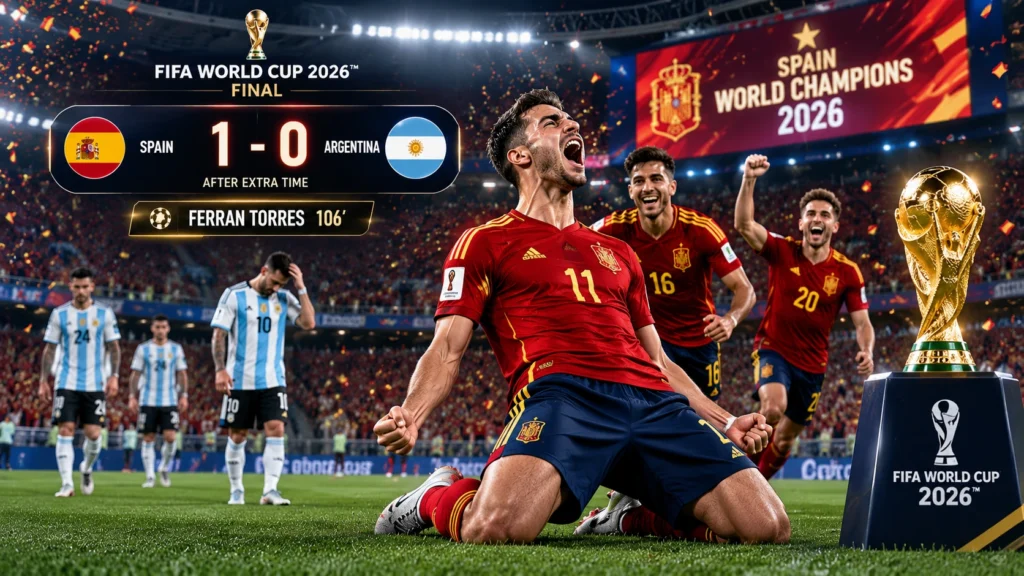
The campaign ended on 19 July 2026 at New York New Jersey Stadium, where Spain defeated defending champions Argentina 1–0 after extra time to claim their second World Cup title.
But their road to the trophy was far from straightforward.
A Slow Start Against Cabo Verde
Spain entered the tournament among the favourites, but their opening performance immediately provided a warning that nothing would come easily.
La Roja were held to a 0–0 draw by Cabo Verde.
For a team expected to dominate possession and create chances, it was a frustrating beginning. Ferran Torres started the opening match but subsequently lost his place in the starting XI.
Rather than defining Spain’s tournament, however, the result became the starting point for their improvement.
And the response came quickly.
Spain 4–0 Saudi Arabia: The Tournament Comes Alive
Spain looked completely different in their second group match.
A commanding 4–0 victory over Saudi Arabia gave La Roja their first win and injected momentum into their campaign.
It also demonstrated something that would become increasingly important as the tournament progressed: Spain had several different ways to control matches.
They could dominate the ball, press aggressively when possession was lost and use technically gifted wide players such as Lamine Yamal and Nico Williams to stretch opposition defences.
FIFA later highlighted Spain’s ability to combine pressing, possession, counter-attacks and set pieces, with captain Rodri at the centre of their system.
Uruguay 0–1 Spain: Another Clean Sheet
Spain finished the group stage with a narrow 1–0 victory over Uruguay.
The result may not have been spectacular, but it highlighted what would eventually become one of the defining characteristics of their World Cup victory: an almost unbeatable defence.
Spain had now completed all three group matches without conceding.
That defensive strength would follow them deep into the knockout rounds.
Spain 3–0 Austria: A Statement in the Round of 32
The expanded 48-team World Cup introduced a Round of 32, meaning the eventual champions needed to survive an additional knockout match.
Spain faced Austria and produced one of their most convincing performances of the tournament.
Spain 3–0 Austria.
Another victory.
Another clean sheet.
And La Roja were safely through to the Round of 16.
By this stage, Spain’s formula was becoming clear: control the midfield, limit opposition chances and patiently create opportunities rather than turning matches into end-to-end contests.
Portugal 0–1 Spain: Surviving a Huge Test
The Round of 16 brought one of Spain’s biggest challenges: Portugal.
This was exactly the type of match capable of ending a World Cup campaign.
Spain eventually escaped with a 1–0 victory, but the decisive moment arrived late.
Ferran Torres, despite no longer being a regular starter, played an important role. He found Mikel Merino, whose finish sent Spain through to the quarter-finals.
Torres’ contribution was particularly significant considering how his tournament had begun.
It would not be his last decisive intervention.
Spain 2–1 Belgium: The Defence Is Finally Beaten
Belgium accomplished something no other team managed during Spain’s entire World Cup campaign:
They scored against them.
Spain nevertheless won the quarter-final 2–1 and advanced to the final four.
Remarkably, that Belgium goal would be the only goal Spain conceded in eight matches at the 2026 World Cup.
That statistic tells much of the story behind their success.
Spain were technically excellent going forward, but their defensive performance was extraordinary.
Goalkeeper Unai Simón recorded seven clean sheets in eight matches, a new record for clean sheets in a single World Cup according to FIFA.
France 0–2 Spain: A Place in the Final
Waiting in the semi-final were France.
Spain responded with another controlled performance and won 2–0, booking their place in the World Cup final for only the second time in their history.
Their record heading into the final was remarkable:
Seven matches. Six clean sheets. Just one goal conceded.
But one final obstacle remained.
And it was perhaps the biggest possible challenge.
Defending world champions Argentina.
Spain vs Argentina: A Final Worthy of the World Cup
The 2026 final brought together two giants.
Argentina were defending the title they had won in 2022 and had reached a second consecutive World Cup final.
Spain were attempting to complete their return to the summit of international football.
The match remained goalless throughout the opening 90 minutes.
Spain 0–0 Argentina.
Extra time was required.
Then, in the 106th minute, Spain finally found their breakthrough.
Pedro Porro delivered the ball into the area. Nico Williams headed it down, and substitute Ferran Torres finished the move.
Spain led 1–0.
This time there would be no response.
After 120 minutes:
Spain 1–0 Argentina.
La Roja were world champions.
Ferran Torres: From Frustration to World Cup Hero
Few players had a more dramatic tournament story than Ferran Torres.
He started Spain’s disappointing opening draw against Cabo Verde before losing his place.
Against Saudi Arabia, he came off the bench and even had a late goal disallowed for offside.
Yet Torres continued contributing when opportunities arrived.
He helped create Spain’s late winner against Portugal.
Then came the biggest moment of all.
His 106th-minute goal against Argentina made him only the second Spaniard, after Andrés Iniesta, to score a World Cup-winning goal.
From losing his starting position to scoring the goal that won the World Cup, Torres produced one of the tournament’s great individual stories.
Rodri: The Player Who Controlled Spain
If Torres delivered the defining goal, Rodri was the player who controlled Spain’s tournament.
The midfielder operated at the heart of Luis de la Fuente’s system, linking defence and attack while providing positioning, interceptions and passing control.
His final against Argentina demonstrated his influence.
Rodri completed 101 of 105 passes, won 80 percent of his duels and created two chances.
Across the tournament, his performances earned him the FIFA World Cup 2026 Golden Ball as the competition’s best player.
Spain didn’t simply keep possession for the sake of it.
Rodri helped dictate when they should accelerate, when they should press and when they should control the tempo.
Spain’s Incredible Defensive Record
Perhaps the most remarkable statistic from Spain’s triumph was this:
Spain conceded only one goal in the entire tournament.
Eight matches produced seven clean sheets.
Unai Simón’s seven shutouts were the most ever recorded by a goalkeeper at a single World Cup, earning him the Golden Glove.
Young centre-back Pau Cubarsí also played an important role and received FIFA’s Best Young Player Award.
Spain’s defensive structure allowed their creative players freedom because the team rarely lost control when possession changed hands.
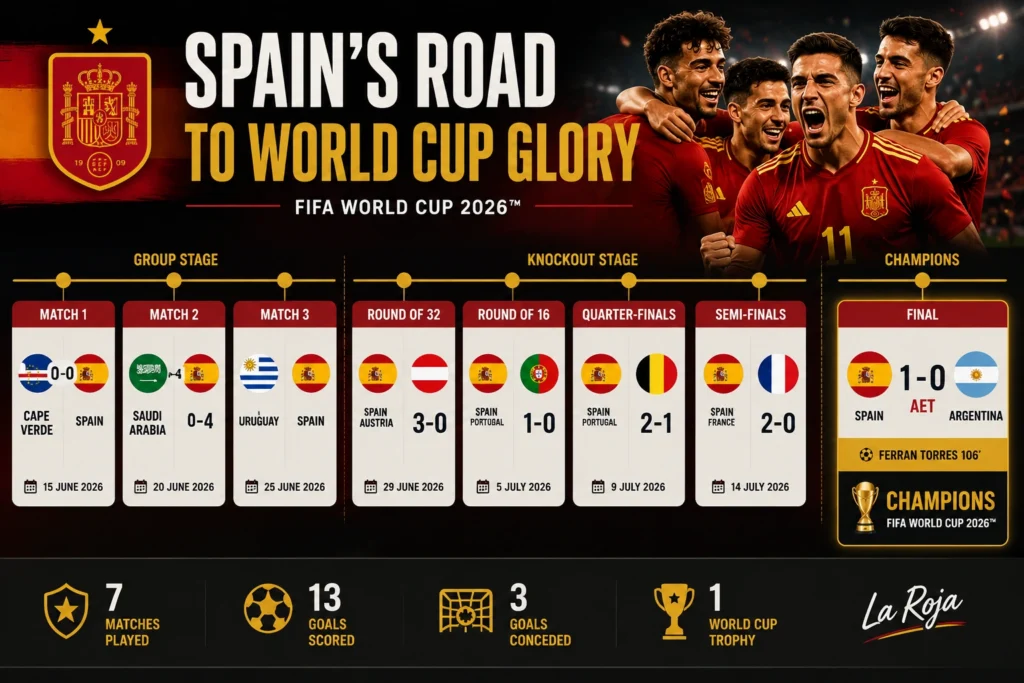
Spain’s Complete Route to the 2026 World Cup Trophy
| Stage | Match | Result |
| Group Stage | Spain vs Cabo Verde | 0–0 |
| Group Stage | Spain vs Saudi Arabia | 4–0 |
| Group Stage | Uruguay vs Spain | 0–1 |
| Round of 32 | Spain vs Austria | 3–0 |
| Round of 16 | Portugal vs Spain | 0–1 |
| Quarter-final | Spain vs Belgium | 2–1 |
| Semi-final | France vs Spain | 0–2 |
| Final | Spain vs Argentina | 1–0 AET |
These results are confirmed in FIFA’s official recap of Spain’s route to the trophy.
Across eight matches, Spain therefore finished the tournament unbeaten, scoring 14 goals and conceding only once.
The Players Behind Spain’s Success
Spain’s triumph was ultimately about the team rather than one superstar.
Rodri controlled midfield and won the Golden Ball.
Unai Simón provided historic consistency in goal.
Pau Cubarsí emerged as one of the tournament’s outstanding young players.
Lamine Yamal and Nico Williams provided attacking creativity and width.
And when Spain needed one final decisive moment, Ferran Torres delivered it.
The result was an unusually complete team.
As Rodri explained during the tournament, Spain were capable of mastering multiple phases of the game rather than relying on possession alone.
Spain Are World Champions Again
Spain’s first World Cup triumph in 2010 became famous for a generation built around possession and technical excellence.
The 2026 champions had some of those same characteristics, but this team added another dimension.
They could control possession.
They could press.
They could counter.
And most importantly, they were extraordinarily difficult to score against.
From the frustrating 0–0 opening draw against Cabo Verde to Ferran Torres’ extra-time winner against Argentina, Spain improved as the pressure increased.
Eight matches later, they had conceded just once and lifted the World Cup for the second time in their history.
Spain were champions of the world again.