

Spain defeated Argentina 1–0 after extra time to win the 2026 FIFA World Cup. From midfield control and Argentina’s defensive resistance to Ferran Torres’ historic winner, here’s what decided the final.
For 105 minutes, the 2026 FIFA World Cup final remained locked.
Spain controlled possession. Argentina defended. Emiliano Martínez made save after save. Lionel Messi searched for an opening.
But the breakthrough refused to arrive.
Then came the 106th minute.
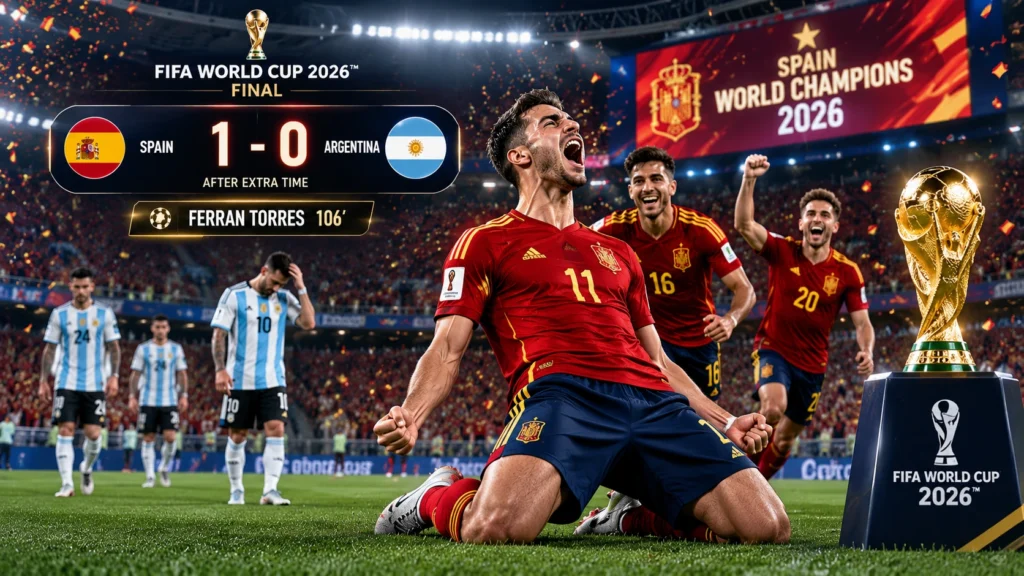
Pedro Porro delivered from the right, Nico Williams headed the ball back across the area and substitute Ferran Torres struck first time.
Spain 1–0 Argentina.
That single moment ultimately decided the World Cup, but Spain’s victory was about much more than one goal.
Their control of midfield, defensive structure, patience and ability to keep Argentina’s biggest attacking threats away from goal gradually tilted the final in their favour.
Here’s how Spain won the biggest match in world football.
Spain vs Argentina 2026 Final at a Glance
| Detail | Result |
| Competition | FIFA World Cup 2026 Final |
| Date | 19 July 2026 |
| Stadium | New York New Jersey Stadium |
| Result | Spain 1–0 Argentina |
| After 90 minutes | 0–0 |
| Winning goal | Ferran Torres |
| Goal time | 106th minute |
| Spain coach | Luis de la Fuente |
| Argentina status | Defending world champions |
Spain’s victory delivered the country’s second men’s World Cup title, following their first triumph in 2010.
The victory completed an extraordinary campaign for La Roja. See how Spain won the 2026 FIFA World Cup and the path they took from the group stage to the final.
1. Spain Took Control From the Beginning
The first major reason Spain won was simple: they controlled where the match was played.
Argentina had arrived at the final with a dangerous attack and 19 goals during their run to the decisive match.
But Spain prevented the defending champions from playing the type of game they wanted.
La Roja controlled possession and forced Argentina to spend long periods without the ball.
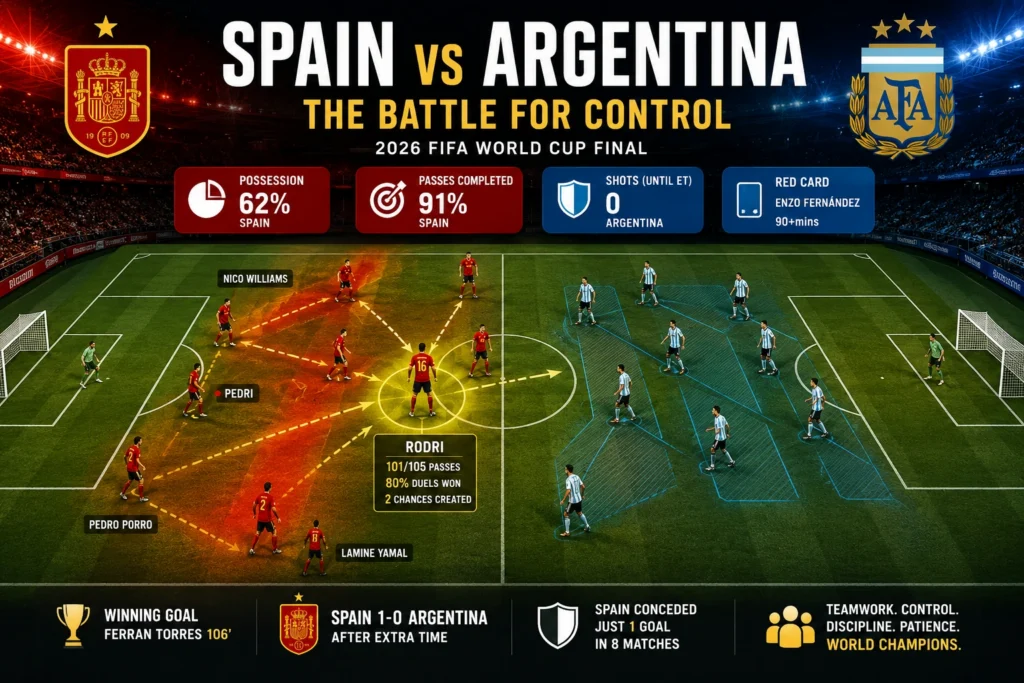
Rodri sat at the centre of everything.
Spain circulated possession patiently instead of forcing risky attacks, repeatedly moving Argentina’s defensive structure from one side of the pitch to the other.
The strategy wasn’t designed simply to produce attractive possession statistics.
It prevented Argentina from attacking.
And the extent of Spain’s control was remarkable.
According to FIFA’s match report, Argentina did not register a single attempt until extra time.
For a team that had scored 19 times on its way to the final, that was an extraordinary achievement by Spain.
2. Rodri Controlled the Midfield
If one player represented Spain’s approach better than anyone, it was Rodri.
The midfielder had already been central to La Roja’s run through the tournament, but his performance in the final demonstrated exactly why.
Rodri completed 101 of his 105 passes, won 80 percent of his duels and created two chances against Argentina.
Those numbers tell part of the story.
More importantly, Rodri gave Spain control.
When Argentina tried to press, he helped Spain escape.
When Spain needed to slow the match down, he provided an outlet.
When possession was lost, his positioning helped prevent Argentina from launching dangerous transitions.
His performances throughout the tournament ultimately earned him the 2026 World Cup Golden Ball.
Spain had plenty of attacking talent, but Rodri provided the platform that allowed it to function.
3. Emiliano Martínez Kept Argentina Alive
Spain controlled the final, but dominance does not automatically produce goals.
One major obstacle stood between La Roja and the trophy:
Emiliano Martínez.
Argentina’s goalkeeper produced several important saves as Spain increased the pressure.
Pau Cubarsí tested him.
Pedri tested him after coming from the bench.
Nico Williams forced another save.
And near the end of normal time, Martínez produced a flying stop from a Lamine Yamal free-kick.
Without those interventions, Spain might have settled the final inside 90 minutes.
Instead, Argentina survived.
At 0–0, one counter-attack, set piece or individual moment could still have changed everything.
Martínez had given the defending champions a chance.
4. Spain Neutralised Argentina’s Attack
Keeping Argentina scoreless was impressive.
Keeping them without a shot until extra time was something else entirely.
Spain’s defence rarely allowed Argentina’s attacking players to receive possession in truly dangerous areas.
Pau Cubarsí and the Spanish back line remained disciplined, while Rodri helped protect the space in front of them.
That structure was not unique to the final.
Spain conceded just one goal across eight matches during their entire World Cup campaign.
Argentina therefore encountered arguably the tournament’s most difficult defence at exactly the wrong time.
Even Lionel Messi struggled to transform possession into clear opportunities.
Spain didn’t need to completely remove Argentina from the game.
They simply prevented Argentina from turning their moments on the ball into genuine danger.
5. Enzo Fernández’s Red Card Changed the Equation
Argentina’s challenge became even more difficult late in normal time.
During second-half stoppage time, Enzo Fernández was sent off following a challenge on Pau Cubarsí.
Argentina were suddenly preparing for extra time with ten men.
Against a Spanish team already controlling possession, that was an enormous problem.
More space became available.
Argentina had to defend deeper.
And Spain could continue moving the ball while forcing an increasingly tired opponent to chase it.
The red card did not score the winning goal.
But it changed the conditions under which the final would be decided.
Spain Kept Pushing in Extra Time
Extra time followed a familiar pattern.
Spain attacked.
Argentina resisted.
Martínez saved again, this time denying a Nico Williams header.
Mikel Merino sent another opportunity wide.
Williams and Torres both had efforts ruled out.
Argentina were hanging on.
But Spain never abandoned their approach.
They continued circulating the ball, searching for the opening that had escaped them throughout normal time.
Eventually, it appeared.
6. The 106th Minute: The Move That Won the World Cup
The decisive attack began with Pedro Porro.
The Spanish right-back delivered a cross towards the far side of the penalty area.
Nico Williams met it and headed the ball back into a dangerous central position.
Waiting was Ferran Torres.
Torres struck the ball first time into the roof of the net.
Martínez, who had stopped almost everything Spain had thrown at him, could do nothing.
106 minutes: Spain 1–0 Argentina.
It was a beautifully simple goal.
Cross.
Header.
Finish.
And after more than 100 minutes of Spanish pressure, Argentina had finally been broken.
Think you remember every detail from the final? Test yourself with our Spain vs Argentina 2026 World Cup Final Quiz.
7. Ferran Torres Became the Unlikely Hero
There was something particularly fitting about the identity of Spain’s match-winner.
Torres had started Spain’s opening match against Cabo Verde, a frustrating 0–0 draw, before losing his place in the starting XI.
Yet he remained useful throughout the tournament.
And in the biggest match of all, Luis de la Fuente turned to him from the bench.
Torres responded with the goal that made Spain world champions.
His journey from losing his starting position to scoring the winning goal in a World Cup final became one of the defining stories of Spain’s tournament.
Spain’s 2010 triumph had Andrés Iniesta.
Spain’s 2026 triumph now had Ferran Torres.
8. Luis de la Fuente Trusted His System
Spain entered the final with confidence in the structure that had taken them through the tournament.
Luis de la Fuente even selected the same starting XI that had beaten France 2–0 in the semi-final.
There was no dramatic tactical reinvention for Argentina.
Spain trusted their identity.
They wanted the ball.
They wanted midfield control.
They wanted their full-backs and wide players involved.
And they trusted their defensive structure to contain Argentina when possession changed hands.
De la Fuente then used his substitutes to maintain Spain’s intensity.
The ultimate reward came when substitute Ferran Torres scored the winner.
The victory also made De la Fuente the oldest coach to win the men’s FIFA World Cup, at 65 years and 28 days.
9. Argentina Could Never Turn Messi Into the Deciding Factor
The final also carried enormous historical significance for Lionel Messi.
Messi made his 34th World Cup appearance, extending his all-time tournament record.
At 39 years and 25 days, he became the oldest outfield player ever to appear in a World Cup final and the second-oldest player overall to feature in one.
But Spain succeeded where so many teams had failed.
They prevented Messi from deciding the game.
Rather than allowing Argentina to repeatedly find him near Spain’s penalty area, La Roja’s control forced much of Argentina’s work to happen further from goal.
Messi remained one of the match’s biggest threats simply because of what he could create at any moment.
Spain made sure those moments were rare.
So, What Really Decided Spain vs Argentina?
It would be easy to say the final was decided by Ferran Torres’ goal.
Technically, it was.
But the goal was the final result of several advantages Spain had built throughout the match.
Spain controlled midfield.
Rodri dictated possession and prevented Argentina from turning the final into an open contest.
Spain neutralised Argentina’s attack.
A team that entered the final having scored 19 tournament goals failed to record an attempt until extra time.
Spain remained patient.
Even after Martínez repeatedly denied them, La Roja continued playing the same way rather than becoming desperate.
Argentina went down to ten men.
Fernández’s dismissal made surviving extra time considerably more difficult.
And finally:
Spain’s substitutes delivered.
Ferran Torres entered the match and scored the goal that changed Spanish football history.
A Final Full of World Cup History
The match produced several milestones beyond the result.
Spain became world champions for the second time, adding 2026 to their 2010 triumph.
Lamine Yamal and Pau Cubarsí, both 19, became only the fourth and fifth teenagers to appear in a men’s World Cup final.
Spain also became the first nation to simultaneously hold FIFA’s flagship men’s and women’s world titles.
And Messi extended his World Cup appearance record to 34 matches.
It was therefore more than simply a 1–0 final.
It was a match filled with records, generational change and football history.
Spain’s journey was about much more than the final. Test your knowledge of La Roja’s entire campaign with our Spain World Cup 2026 Champions Quiz.
Spain Deserved Their Moment
World Cup finals are often decided by tiny margins.
One mistake.
One save.
One moment of brilliance.
Spain vs Argentina was no different.
Emiliano Martínez kept Argentina alive for more than 100 minutes, but Spain continued applying pressure until the breakthrough finally arrived.
Pedro Porro created the delivery.
Nico Williams supplied the header.
Ferran Torres supplied the finish.
But Spain’s victory had been built long before the ball reached Torres.
Their midfield control, defensive organisation and patience gradually removed Argentina’s options.
The 106th-minute goal was simply the moment when that superiority finally appeared on the scoreboard.
Spain 1–0 Argentina.
And La Roja were champions of the world.