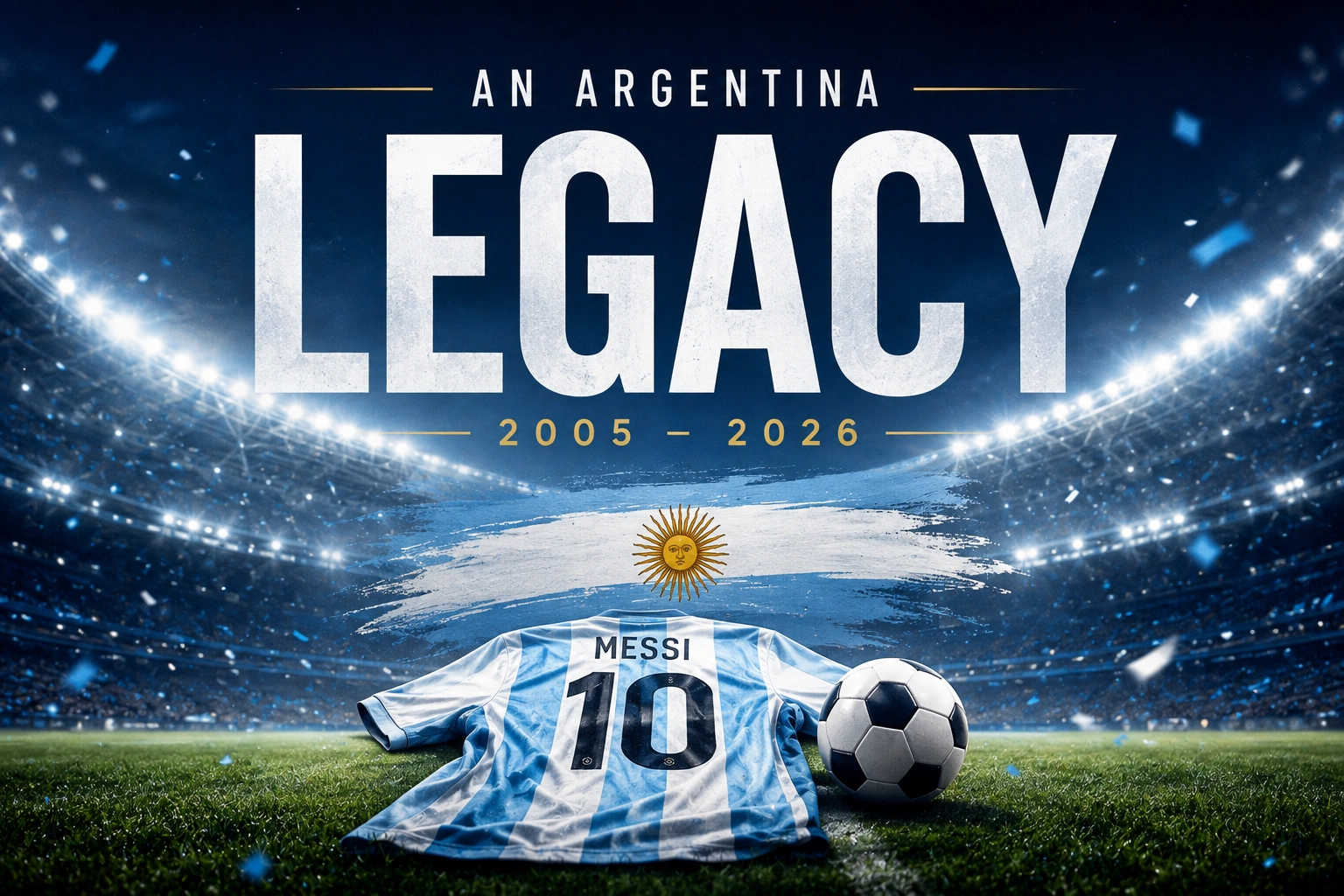

Lionel Messi has officially brought one of the greatest international careers in football history to an end.
The Argentina captain announced his retirement from international football on August 31, 2026, closing a remarkable journey that lasted more than two decades.
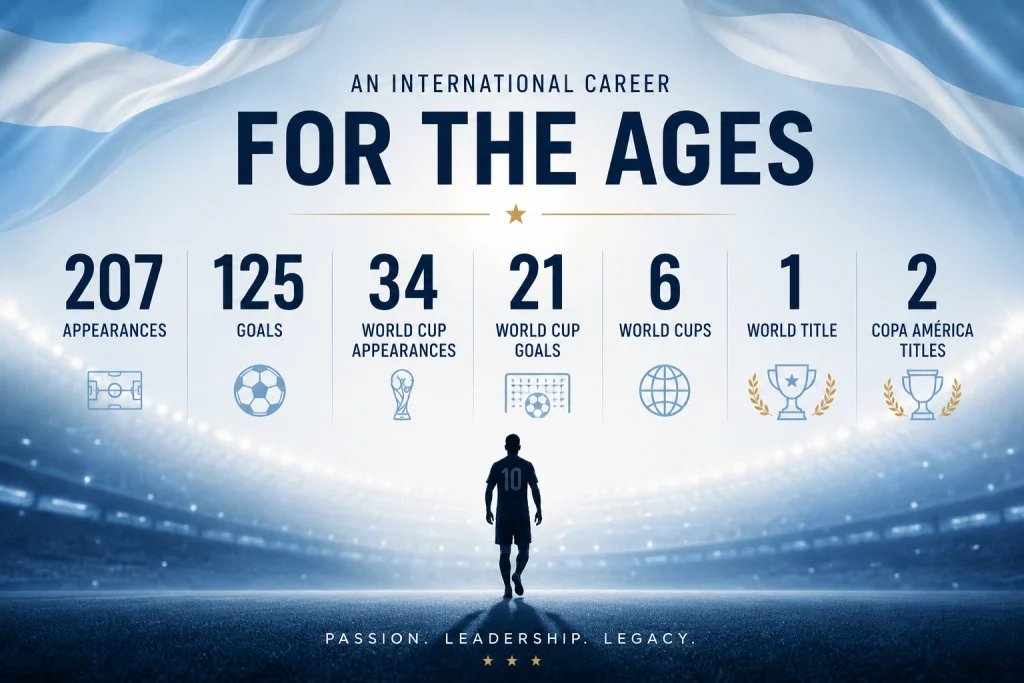
Messi leaves the national team with 207 appearances and 125 goals, making him Argentina’s all-time leader in both categories. He also departs as a World Cup champion, two-time Copa América winner and the player at the centre of one of the greatest redemption stories international football has ever seen.
From painful final defeats to finally lifting the World Cup, Messi’s Argentina career had almost everything.
Now, at 39, the curtain has fallen on his time in the famous blue and white shirt.
Lionel Messi Announces His Argentina Retirement
Messi confirmed his decision following Argentina’s run to the 2026 FIFA World Cup final, where the defending champions were beaten 1-0 by Spain after extra time.
According to FIFA, Messi originally wrote his farewell message on July 21, two days after the final. He ultimately made his retirement public on August 31.
In announcing his decision, Messi reflected on everything he had given to the national team and also pointed toward the talented younger generation ready to take Argentina forward.
It was an emotional conclusion to a relationship that began at senior international level in 2005.
For Argentina supporters, it marks the end of an era that stretched across an entire generation.
Messi Reveals He Wrote His Farewell Two Days After the World Cup Final
Messi also revealed an emotional detail about the timing of his decision.
The farewell message published on his Instagram account was not written on the day he announced his retirement. Messi said he originally wrote the words on July 21, 2026 — just two days after Argentina’s World Cup final defeat to Spain.
He ultimately waited more than a month before sharing them publicly.
Following the death of his father, Jorge Messi, in August, Messi said he felt even more convinced that the time had come to close his chapter with the Argentina national team. FIFA also confirmed that the message had originally been written two days after the World Cup final before Messi eventually shared it with the world.
The handwritten farewell showed just how difficult the decision had been. Messi said he felt he had given everything he could to Argentina and believed a new generation deserved its opportunity.
Rather than walking away from football entirely, Messi will now experience Argentina matches from a different position: as a supporter.
Lionel Messi’s Argentina Career in Numbers
Messi’s international statistics show the extraordinary scale and longevity of his career.
| Record | Lionel Messi |
|---|---|
| Argentina appearances | 207 |
| Argentina goals | 125 |
| Senior international debut | 2005 |
| FIFA World Cups played | 6 |
| World Cup appearances | 34 |
| World Cup goals | 21 |
| FIFA World Cup titles | 1 |
| Copa América titles | 2 |
| Finalissima titles | 1 |
Messi finishes as Argentina’s record appearance-maker and record goalscorer.
His World Cup numbers are equally remarkable. FIFA confirmed that he finished with 34 World Cup appearances, while his 2026 campaign took his World Cup goal total to 21.
But statistics tell only part of the story.
Messi’s relationship with Argentina was defined as much by the defeats he overcame as by the trophies he eventually lifted.
From Heartbreak to Redemption
For much of Messi’s career, international football represented the one major question surrounding his legacy.
His club career was already extraordinary, but trophies with Argentina repeatedly escaped him.
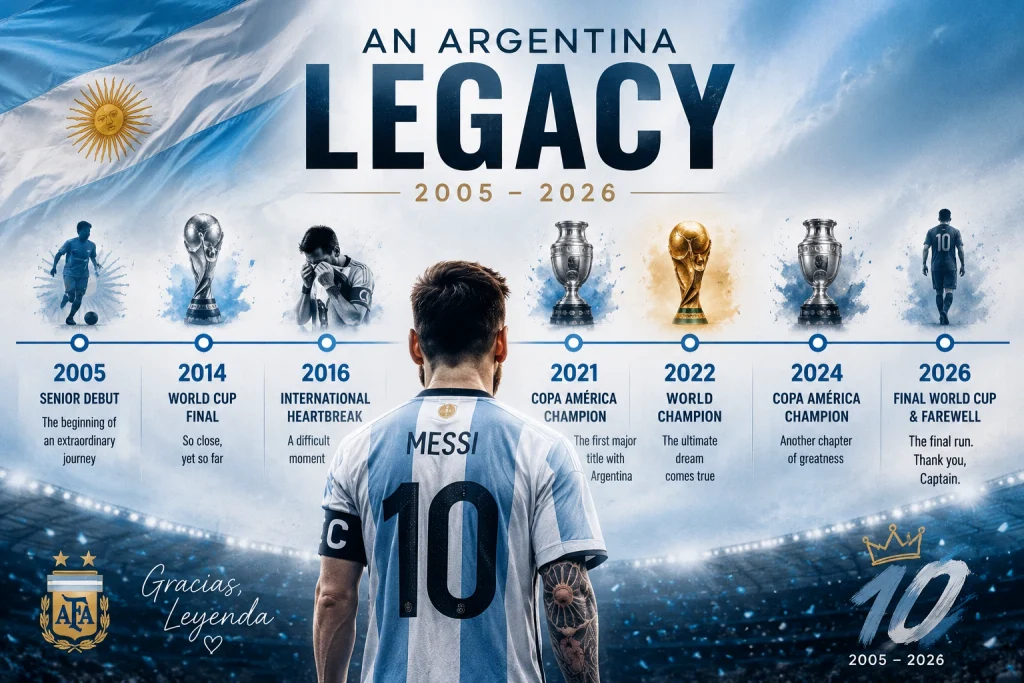
The biggest early disappointment came at the 2014 FIFA World Cup, when Argentina reached the final but lost to Germany.
Further heartbreak followed.
Argentina lost consecutive Copa América finals to Chile in 2015 and 2016.
After the 2016 defeat, Messi briefly announced that his international career was over.
At that point, it seemed possible that one of football’s greatest players could finish his Argentina career without winning a major senior international trophy.
He eventually reversed that decision.
That choice would change the story of his career forever.
Copa América 2021 Changed Everything
The breakthrough finally arrived at the 2021 Copa América.
Argentina defeated Brazil in the final at the Maracanã to become South American champions.
For Messi, the victory carried enormous significance.
After years of defeats, criticism and questions about his international legacy, he finally had a major senior trophy with Argentina.
But it was only the beginning of an extraordinary period.
World Champion in 2022
One year later came the defining achievement of Messi’s international career.
Argentina entered the 2022 FIFA World Cup in Qatar as one of the favourites, only to suffer a stunning defeat against Saudi Arabia in their opening match.
Instead of collapsing, Argentina recovered.
They progressed through the tournament and eventually reached the final against France.
What followed became one of the most dramatic World Cup finals ever played.
After a 3-3 draw following extra time, Argentina defeated France on penalties.
Messi was finally a FIFA World Cup champion.
After years of comparisons, near-misses and international disappointment, the biggest trophy in football was finally his.
For many supporters, the image of Messi lifting the World Cup in Qatar became the defining image of his career.
Another Copa América Triumph in 2024
Winning the World Cup did not end Argentina’s successful era.
Messi and Argentina followed their Qatar triumph by winning another Copa América in 2024.
It gave Messi his second Copa América title and further strengthened the legacy of an Argentina generation that had transformed itself from repeated finalists into serial winners.
The contrast with the first half of Messi’s international career could hardly have been greater.
The question was no longer whether Messi could win with Argentina.
The question became how much more he could achieve before the end.
One Final World Cup Run in 2026
Messi returned for one final World Cup in 2026 at the age of 39.
And somehow, there was still more history to make.
He scored eight goals during the tournament and helped the defending champions reach another final. FIFA records also show that Messi extended his all-time World Cup appearance record to 34 matches.
His longevity produced another remarkable milestone.
At 39 years and 25 days, Messi became the oldest outfield player ever to appear in a FIFA World Cup final.
Argentina entered the final hoping to become back-to-back world champions.
Spain stood in their way.
The match remained scoreless through 90 minutes before Spain eventually won 1-0 after extra time in New York New Jersey.
There would be no fairytale second World Cup trophy for Messi.
But by then, he no longer needed one to validate his international career.
Messi’s Major Trophies With Argentina
Messi’s senior international trophy collection ultimately included:
FIFA World Cup — 2022
Copa América — 2021
Finalissima — 2022
Copa América — 2024
Earlier in his career, Messi also won the 2005 FIFA World Youth Championship and an Olympic gold medal with Argentina at the 2008 Beijing Olympics.
For a player who spent so many years being asked why he had not won a major senior international trophy, the transformation was extraordinary.
Is Lionel Messi Retiring From Football Completely?
No.
This is an important distinction.
Messi has announced his retirement from international football with Argentina, not his retirement from professional football altogether.
He remains an Inter Miami player and continues to compete at club level.
In fact, just one day before the international retirement announcement, Messi scored four goals and provided an assist as Inter Miami defeated CF Montréal 7-1, demonstrating that he remains capable of producing extraordinary performances even at 39.
Football fans may therefore still have opportunities to watch Messi play.
What has ended is his extraordinary journey with Argentina.
What Happens to Argentina Without Messi?
Argentina now faces a challenge it has known would eventually arrive.
For more than two decades, Messi has been the central figure of the national team.
Replacing 125 international goals is difficult enough.
Replacing his creativity, leadership, experience and influence is something else entirely.
But Argentina cannot simply search for “the next Messi.”
Players like Messi are not easily replaced.
Instead, the national team will need to build its next generation around a new identity and allow younger players to take greater responsibility.
Messi himself acknowledged the quality of the emerging generation when announcing his retirement.
Argentina’s next chapter begins now.
Lionel Messi’s World Cup Legacy
Messi’s World Cup career alone would be enough to establish him among the competition’s greatest-ever players.
He appeared at six World Cups, eventually playing a record 34 matches.
He experienced almost every possible World Cup emotion along the way.
There was disappointment in his early tournaments.
There was the devastating defeat in the 2014 final.
There was redemption and ultimate glory in Qatar in 2022.
And there was one final run to the final in 2026.
His last World Cup ended in defeat, but it also produced more records and eight additional goals.
Few players have remained decisive on football’s biggest stage across such a long period.
From 2016 Retirement to World Cup Glory
Perhaps the most remarkable part of Messi’s Argentina story is what could have happened instead.
In 2016, after losing another Copa América final, Messi announced that he was finished with the national team.
Had that decision remained permanent, his international story would look completely different.
There would have been no Copa América 2021 triumph.
No Finalissima.
No World Cup victory in Qatar.
No second Copa América.
No final World Cup run at 39.
Instead, Messi returned.
And the years that followed transformed his Argentina legacy.
It is difficult to imagine a better example of how quickly football history can change.
Messi’s Argentina Legacy
Messi’s international career can almost be divided into two stories.
The first is about an extraordinary footballer chasing something that repeatedly seemed to escape him.
The second is about persistence finally being rewarded.
He went from losing major finals and temporarily walking away from the national team to captaining Argentina through one of the most successful periods in its modern history.
He leaves as:
Argentina’s all-time leading goalscorer.
Argentina’s most-capped player.
A FIFA World Cup champion.
A two-time Copa América champion.
A six-time World Cup participant.
And one of the defining players in the history of international football.
The End of an Era
Lionel Messi’s international retirement represents more than the departure of a great player.
It closes a chapter that football fans around the world followed for more than 20 years.
They watched a teenage Messi enter the Argentina team with enormous expectations.
They watched the World Cup heartbreak.
They watched the lost finals.
They watched him briefly walk away.
Then they watched him return, conquer South America and finally lift the trophy he had spent his career chasing.
The 2026 World Cup did not provide the perfect ending.
Spain took the trophy.
But Messi’s legacy had already been secured.
207 appearances.
125 goals.
Six World Cups.
Two Copa América titles.
One World Cup trophy.
And more than two decades representing Argentina.
Lionel Messi’s international career is over.
The story he leaves behind will be remembered for generations.